- #furnace repair
- #furnace repair cost
- #edmonton
- #igniter
- #flame sensor
- #no heat
Quick answer: Most furnace repairs in Edmonton cost between $129 and $1,400 in 2026, depending on the part. A regular-hours service call is typically $129 to $199, an igniter $225 to $450, a pressure switch $275 to $550, and the big items, an ECM blower motor or module, run $900 to $2,000. These are typical Edmonton ranges; your price is confirmed in writing before any work starts.
Below is the part-by-part list, what each failure looks like from the house side, and how to tell a repair worth doing from one that is money into a furnace near its end.
The 2026 repair price list
Typical Edmonton ranges, Canadian dollars, before GST.
| Repair | Typical Edmonton range | What you usually notice |
|---|---|---|
| Diagnostic / service call (regular hours) | $129–$199 | Any no-heat or odd-noise call |
| After-hours, weekend or holiday no-heat call | $199–$349 | Furnace quits Saturday night at -25°C |
| Flame sensor clean or replace | $129–$299 | Burners light, then shut off after a few seconds |
| Hot surface igniter replacement | $225–$450 | Inducer runs, no glow, no flame, lockout |
| Pressure switch replacement | $275–$550 | Inducer runs, furnace never lights, error code |
| Blower capacitor | $175–$350 | Blower hums or starts slowly, burners overheat |
| Limit or rollout switch | $225–$450 | Short cycling, burners shut off on heat |
| Inducer (draft) motor | $650–$1,400 | Loud whine or rattle at start, or no start |
| Blower motor (PSC) | $600–$1,200 | No air at the vents, burners cycle off |
| ECM blower motor or module | $900–$2,000 | No air, or airflow that surges on newer furnaces |
| Control board | $500–$1,200 | Nothing happens, or random behaviour and codes |
| Gas valve | $550–$1,100 | Igniter glows, no gas, no flame |
| Frozen condensate line / trap thaw and reroute | $150–$450 | High-efficiency furnace off in a cold snap |
| Blocked/frosted vent clear and vent termination kit fix | $150–$600 | Furnace off after snow or frost, pressure switch code |
The complete list, including maintenance and replacements, is on the pricing page.
The cheap repairs, and why they are common here
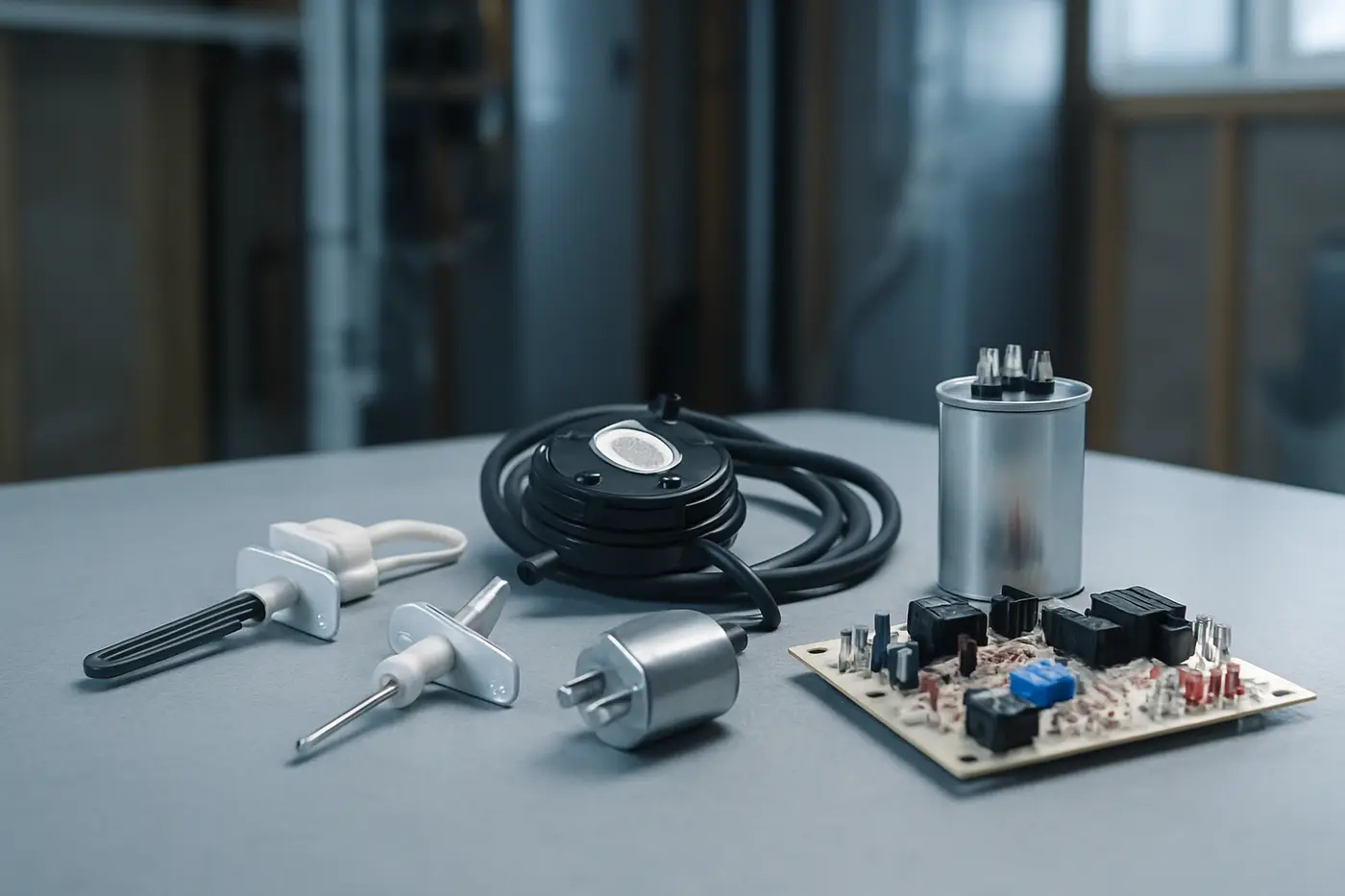
Flame sensor. A thin metal rod that proves the flame is lit. It picks up a coating over time, and when it cannot read the flame the furnace shuts the gas off after a few seconds and tries again, then locks out. Cleaning it is one of the most common winter calls and one of the cheapest, $129 to $299, and it is also the kind of thing a yearly furnace tune-up catches before January.
Hot surface igniter. The part that glows to light the gas. It is brittle, it wears out, and it cracks. On a 10- or 12-year-old furnace, a $225 to $450 igniter is the textbook case where repair is the right call.
Frozen condensate and blocked vents. High-efficiency furnaces vent through PVC pipes in the side wall. Drifting snow, ice build-up and frost from the exhaust plume block the intake or exhaust, and the furnace shuts down on its pressure switch. Condensate lines that run near a cold wall or to a floor drain in an unheated space freeze. These are among the most common no-heat calls in an Edmonton January, and they are cheaper than people fear: $150 to $450 to thaw and reroute a condensate line, $150 to $600 to clear a vent and fix the termination. Newer subdivisions, where the side-wall pipes sit close to a drift-prone side yard, see a lot of these. Before booking, it is worth reading the safe checks in furnace not working: checks before you call, because clearing snow from the pipes outside is something you can do yourself.
The middle repairs
Pressure switch and hose. The pressure switch confirms the inducer is pulling air through the venting before the furnace lights. A cracked hose, a plugged port or a failed switch stops the sequence. Many pressure switch codes are really a vent or condensate problem, so a technician should check the venting and trap before replacing the switch. Replacement runs $275 to $550.
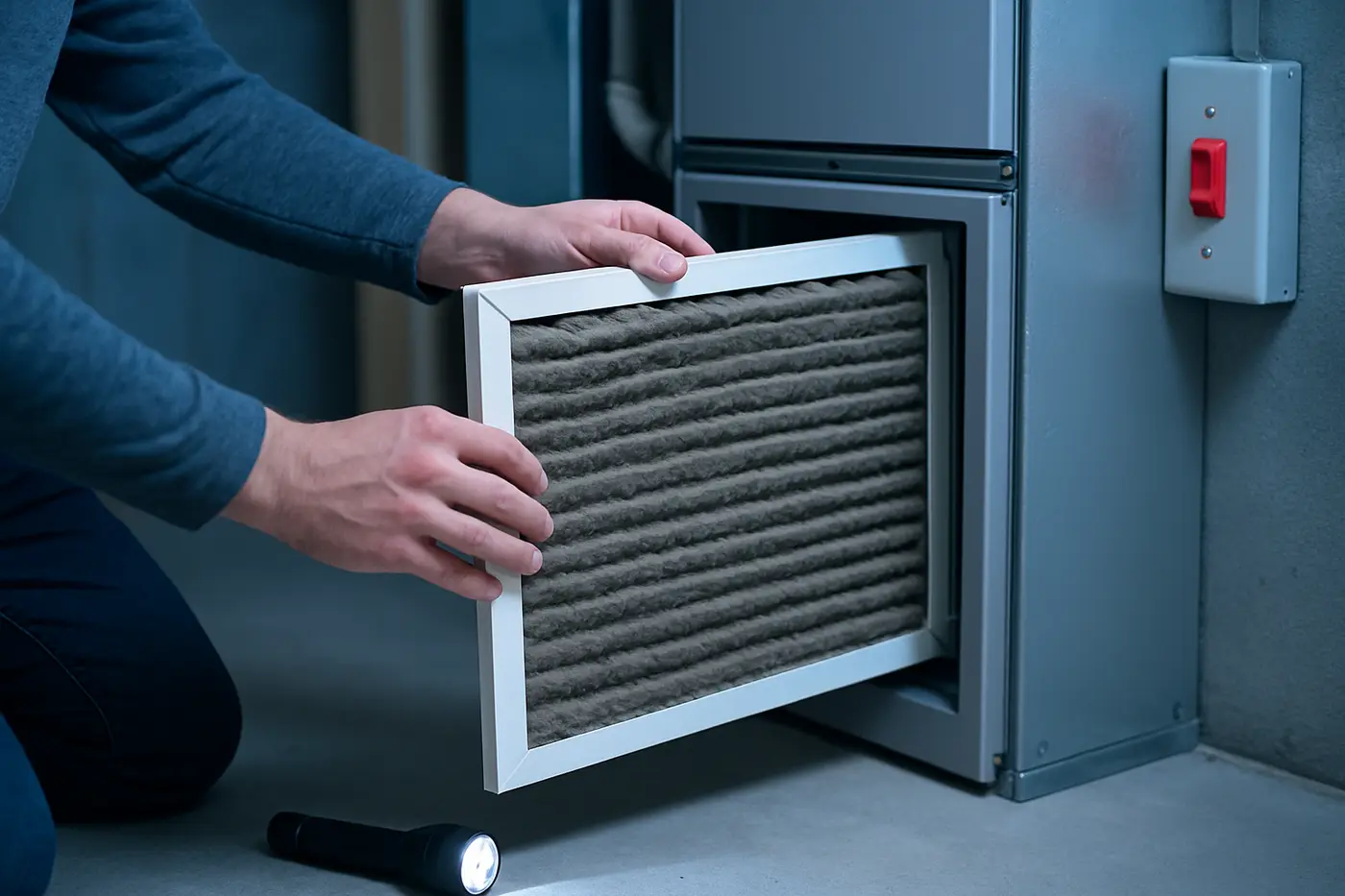
Limit and rollout switches. These are safety switches. A limit switch trips when the furnace overheats, most often because a clogged filter or blocked returns choke the airflow. A rollout switch trips when flame rolls out of the burner area, which points to a venting problem or a heat exchanger issue. Replacing either runs $225 to $450, but the switch is rarely the root cause, and a switch that keeps tripping needs its cause found. Never bypass one.
Blower capacitor. On furnaces with a PSC blower motor, the capacitor helps the motor start. A weak one leaves the blower humming or turning slowly. At $175 to $350, it is a quick fix.
Control board and gas valve. A control board at $500 to $1,200 and a gas valve at $550 to $1,100 are real money, and both are sometimes blamed for faults that live elsewhere. Ask what the technician measured to condemn the part.
The expensive repairs
Inducer motor. The small fan that pulls combustion gases through the heat exchanger and out the vent. Bearings wear and it starts to whine or rattle on start-up. $650 to $1,400.
Blower motor. A PSC blower motor runs $600 to $1,200. An ECM blower motor or module, found on many newer and two-stage furnaces, runs $900 to $2,000. That is the point where the age of the furnace starts to matter a lot.
Cracked heat exchanger. This is not on the repair list because it usually means replacement. A cracked heat exchanger can let combustion gases, including carbon monoxide, into the air stream, and on most residential furnaces the heat exchanger part plus labour approaches the cost of a new furnace. If one is found, the furnace should be shut down, and the conversation moves to furnace replacement.
When to repair and when to stop
A simple rule that holds up in most Edmonton houses: if the furnace is under about 15 years old, the heat exchanger is sound, and the repair is one of the cheap or middle items, repair it. A 15-year-old furnace is often worth one more repair. If the furnace is past 20, has needed two or three major parts in the last couple of winters, or the repair is an ECM motor or inducer on a unit near the end of its 15- to 20-year service life, get a replacement quote alongside the repair quote and compare.
| Situation | Usually the better call |
|---|---|
| 12-year-old furnace, failed igniter | Repair ($225–$450) |
| 15-year-old furnace, dirty flame sensor | Repair and tune-up |
| 17-year-old furnace, frozen condensate line | Repair and reroute the line ($150–$450) |
| 19-year-old furnace, failed ECM blower | Price both; replacement often wins |
| Any age, cracked heat exchanger | Replace |
| 22-year-old furnace, third major repair in two winters | Replace |
The full reasoning, including efficiency and the numbers behind the rule, is in repair or replace your furnace. New furnace prices are in how much does a new furnace cost in Edmonton.
After-hours calls
When a furnace quits on a Saturday night during a cold snap, an after-hours, weekend or holiday no-heat call typically runs $199 to $349 before parts. No-heat calls get priority; we confirm the arrival window when we reply to your request. If the house is holding temperature and nobody at home is vulnerable to cold, a regular-hours call the next weekday is cheaper. If the house is falling fast at -30°C, it is not the time to save the difference. More on that in emergency furnace repair.
Where the price differs across the region
The parts cost the same in St. Albert as in Mill Woods, but the house changes the job. A 1920s furnace room in Garneau with a low ceiling and a tight stair takes longer to work in than an open basement in Heritage Valley. A 1970s house in Castle Downs is often on its second or third furnace, and an older unit is more likely to need an inducer or blower motor than a younger one. None of that changes the typical ranges above, but it is why two repairs of the same part can land at different ends of the range.
Safety before price
If you smell gas (rotten eggs), leave the house now. Do not touch light switches, the thermostat or the furnace, do not use a phone inside, and call ATCO Gas’s 24-hour emergency line or 911 from outside. If a CO alarm sounds, or people have headaches or nausea that ease outside, get everyone out and call 911 from outside.
What to do next
Read the error code blinking on the LED through the sight glass in the furnace door, and check it against the chart inside the door. Note the furnace’s age from the rating plate. Then request a visit and tell us what the furnace is doing. The diagnostic finds the failed part, and the repair price is confirmed in writing before any work starts.